Recently in Settlements in Focus

Nokdim Settlement Construction 186x140.jpgToday, Peace Now released a new report entitled "Torpedoing the Two State Solution -- The Strategy of the Netanyahu Government," detailing a number of trends in settlement expansion that directly, and it seems, deliberately, undermine the viability of the two-state solution.


Settlement_Report_Graphic_1-12_320x265.jpg

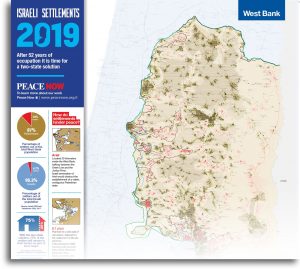
A new report by Peace Now's Settlement Watch project shows that 2011 was a record year in West Bank settlement construction. Worse, the past years highlighted dangerous trends on the ground in the West Bank, which may end up torpedoing a two-state solution: an Israeli government intention to legalize illegal outposts and thus transform them into full-fledged settlements, and building in sensitive locations such as E-1, Efrat, and Givat Hamatos, which would deny contiguity for a future Palestinian state.

The Netanyahu government isn't serious about stopping settler violence.

This is the only possible conclusion. While Netanyahu and his cohorts denounce Jewish extremists and promise to get tough, actions speak louder than words. And their action this week on outposts sent an unmistakable message to the settlers: not only won't you pay a price for terrorism, but you'll be rewarded.

OutpostLieverman186x140.jpgVol. 7, Issue 1

Talk about settlement construction and a possible new settlement freeze is again in the news. In this edition of Settlements in Focus, we will highlight a number of post-moratorium trends, analyze the current talk about a new settlement freeze, and suggest what would actually be required to make a freeze sufficiently credible to restart, or continue for more than a brief interlude, Israeli-Palestinian peace negotiations.  Please note that the numbers in this document reflect the best information that Peace Now has been able to obtain; additional approvals of construction and planning may have been issued that have not yet come to light.


Volume 6, Issue 5

As made clear in our previous analyses of the settlement moratorium, settlement construction since November 2009 has by no means been frozen.  Indeed, so much construction has been permitted under "exceptions" that the moratorium would have to be extended, with no new loopholes, for at least a year before construction on the ground would actually stop.  
 
Extending the current 10-month settlement moratorium, with no new loopholes or exceptions, is vital to Israel and to peace.  Failing to do so will have a devastating impact on efforts to launch successful peace talks and will play into the hands of those who seek to delegitimize Israel. New settlement construction will be seen as a sign that Israel would rather rule over Palestinians than forge peace.

Volume 6, Issue 4

On November 25, 2009, the Government of Israel announced a 10-month moratorium on settlement construction and planning.  In December 2009 we offered an early accounting of the moratorium and its impacts, in the form of a "balance sheet" showing the "liabilities" (negative aspects of the moratorium),  "accounts receivable" (aspects that could turn out to be either negative or positive) and "assets" (positive aspects of the moratorium), and.  In March 2010 we updated this balance sheet. 

Now, six months into the moratorium - with the September 2010 expiration of the moratorium looming large in the minds of policymakers in the US and Israel, as well as in those of the settlers and their supporters - we present our latest balance sheet.


Volume 6; Issue 3

By Lara Friedman, Americans for Peace Now and Daniel Seidemann, Terrestrial Jerusalem
 
You've heard them from Netanyahu, from Barak, from pundits, and from friends and family.  Here we take on directly the bogus excuses offered to justify East Jerusalem settlement expansion.

Volume 6, Issue 2

On November 25, 2009, the Government of Israel announced a 10-month moratorium on settlement construction and planning.  As we noted from the outset, the impact of this decision - both on the ground and on the Obama Administration's efforts to launch new Israeli-Palestinian negotiations - will depend mainly on the good faith (or lack thereof) that characterizes the government of Israel's implementation of the moratorium.

Volume 6, Issue 1

Yesterday marked the two week anniversary (weekiversary?) of the announcement of Israel's settlement moratorium.  Lo those many days ago, when the moratorium was first announced, we welcomed it and expressed our hope that "this Israeli decision, backed by good faith, will be sufficient to catalyze new Israeli-Palestinian peace negotiations. Such negotiations are the only real path for resolving the Israeli-Palestinian conflict...implemented properly, this moratorium could serve the cause of peace."

Despite what some critics say, it is far too early to judge whether the moratorium is a success or failure in serving the cause of peace.  However, it is not too soon for an honest examination of what the moratorium has achieved thus far and the challenges to it that have already arisen.  And it is not too soon to start keeping a balance sheet, given that how the moratorium fares - and is perceived as faring - in these early weeks and days is critical to the credibility of everything the Obama Administration has done thus far and to its efforts going forward.

So let's get to the balance sheet.

Pisgat Ze'ev Tenders Map 320x265.jpgIs something new happening in the East Jerusalem settlement of Pisgat Ze'ev?

Yes. According to a report in yesterday's Hebrew-language business daily "The Marker", the Israel Lands Authority has decided to accept "appeals" by contractors relating to the failed Pisgat Ze'ev tenders, and award contracts for the construction of at least 450 new units.  An image of the article from the print version of The Marker (Hebrew-only) can be viewed/downloaded here.

1
Lara Friedman
Lara F

Lara Friedman is a Person for Peace

Lara Friedman
Ori Nir
Ori N.

Ori Nir is a Person for Peace

Ori Nir
Rabbi Alana Suskin
RabbiSuskin

Rabbi Alana Suskin is a Person for Peace

Rabbi Alana Suskin
David Pine
David P

David Pine is a Person for Peace

David Pine
Hagit Ofran
Hagit O

Hagit Ofran is a Person for Peace

Hagit Ofran
News Nosh
see the APN "facts on the Ground" mapping application
Shalom Achshav

APN's direct connection to Israel